Top Signs You Need Garage Door Service – Don’t Ignore These
A garage door that takes two seconds longer to respond to the opener than it did six months ago isn’t “getting old.” It’s telling you something specific, and the diagnosis usually costs a fraction of the repair you’ll face if you wait. Most doors that strand a car at 7 a.m. were broadcasting the failure for 30 to 60 days beforehand. The sounds, the response times, the wear patterns were all there. Homeowners just didn’t know what they were looking at. If you’d rather have a trained eye read those signals, call (833) 508-9893 and we’ll take a look.
This isn’t a generic checklist. It’s the diagnostic logic we actually use, organized so you can apply it from the driveway.
What Does a Grinding, Squealing, or Popping Garage Door Mean?
Each sound points to a different failure, and they are not interchangeable. Matching the noise to the part is the first step in knowing whether you’re facing a routine adjustment or a repair that shouldn’t wait.
- Grinding: Usually the opener’s trolley carriage, gear, or drive assembly laboring against resistance. On a chain-drive LiftMaster or Chamberlain, grinding often traces to a worn gear or a carriage that’s dragging on a misaligned rail. Left alone, the motor overheats and the logic board follows.
- Squealing: Friction, almost always. Dry rollers, a dry torsion shaft, or hinge points that haven’t seen lubrication. This one is often the cheapest to correct, but it’s the one people ignore longest because the door still opens.
- Popping: A torsion spring winding or unwinding in the wrong spot, or a cable jumping its drum. Popping is a warning, not a symptom you ride out.
- The metallic twang: A single sharp twang, especially on one side, is a cable strand fraying. It is always a cable problem. A frayed cable can let go without notice, and that’s a door off its track and a real injury risk.
Sound is your fastest diagnostic. A door that’s quieted down after being noisy is not fixed. Something has worn through. In Kendall, our wet season adds humidity that changes how loud rollers and hinges run, so a sound that appears in the rainy months is worth a second look.
What Is the Two-Second Response Test?
The two-second response test is the simplest way to track your opener’s health over time. It measures how long the door takes to move after you press the button, and compares that against what’s normal for your door.
- Press the wall button with a stopwatch or phone timer running, and note the delay before the door first moves.
- Write that number down. That’s your baseline.
- Repeat the test about once a month, and after any storm or power outage.
- Compare. If the delay grows by roughly two seconds or more, something is changing.
A growing delay usually points to one of three things: a motor that’s losing torque (often a tired capacitor), a logic board that’s slow to process the signal, or a travel limit that’s drifted out of adjustment. On a Genie or a Craftsman opener, a stretching delay plus a door that reverses on its own is a classic logic-board symptom. Replacing a $90 part now is far better than replacing a $400 opener after the board fails completely and the door won’t move at all. If the delay is intermittent and comes and goes, a loose connection or a failing capacitor is the usual suspect.
How Do You Inspect Torsion Springs Without Touching Them?
You can read a torsion spring’s condition entirely from ground level, and you should never touch one to check. A torsion spring under tension stores enough energy to cause serious injury, and the spring repair itself is one of the most dangerous and most botched DIY jobs in home repair. This is a look-only inspection. If anything below shows up, treat it as a call-a-professional signal.
- The coil gap: A healthy spring has evenly spaced coils. A visible gap, or coils that look stretched compared to the rest of the spring, means it’s losing tension and nearing the end of its life.
- Rust streaking: Orange or brown streaks running down the torsion shaft or along the spring’s paint say moisture is sitting where it shouldn’t. That shortens the spring’s service life and quietly rusts the cable drums it runs near.
- Uneven tension cues: The spring on one side looks tighter or more compressed than the other. A matched pair should wear together. When it doesn’t, one is working harder than the other.
- A visible break: An obvious gap in the winding is a broken spring. The door will be very heavy to lift by hand or won’t lift at all. Don’t force it.
A door with a broken spring is a safety system that’s down, not just an inconvenience. Kendall homes see this most often during the humid stretches, when moisture accelerates corrosion on older hardware.
When Does a Worn Bottom Seal Actually Matter in Kendall?
A worn bottom seal crosses from cosmetic to structural the moment it stops keeping moisture out. That tipping point matters more in Kendall’s wet season than in dry climates, and it’s the one seal problem people most often let slide.
A cracked, flattened, or separated bottom seal lets wind-driven rain and humid air reach the steel track, the hinges, and the cable drums at the bottom corners. Once moisture reaches a cable drum, corrosion starts creeping into the cable itself. That’s how a seal that looked like a $40 cosmetic fix turns into a cable replacement. On a Clopay or Amarr door, a seal that’s torn at the corners is usually the first thing to replace, before the moisture finds the drums.
Cosmetic is when the seal is scuffed but still seated flat and touching the floor along its whole length. It’s a real problem when:
- You can see daylight or feel a draft along the bottom with the door closed.
- The seal is torn, flattened, or pulling away at either corner.
- Water pools at the base of the track after rain.
- Insects or small debris find their way in along the bottom edge.
The wet season is when this gets tested. A seal that’s failing now tends to fail loudly in the first heavy rain.
What Is the Asymmetry Test for Cable Tension?
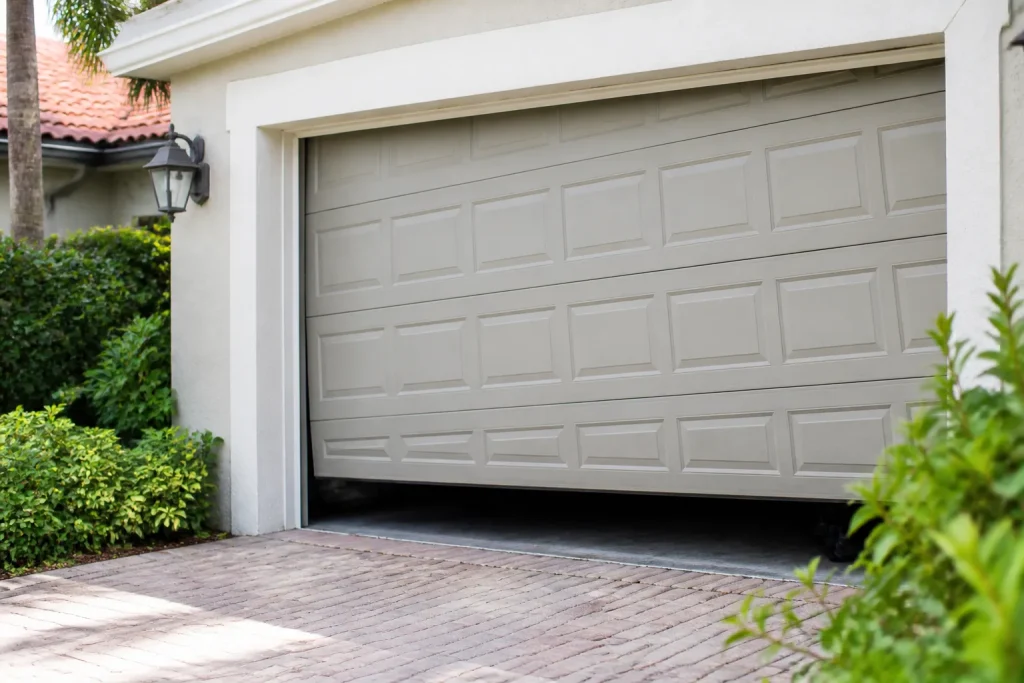
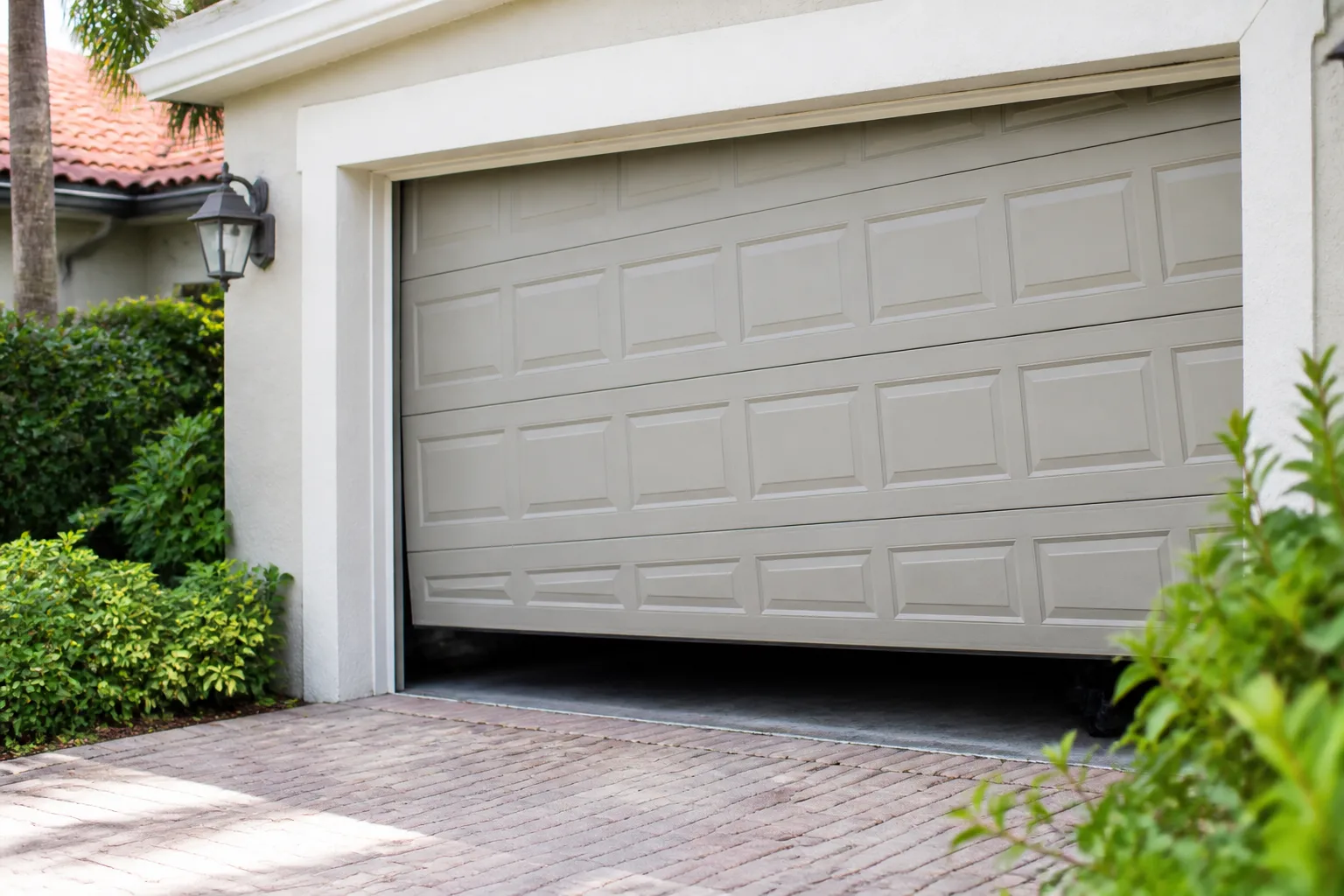
A door that hangs half an inch lower on one side has roughly 10 to 14 days before the cable on that side snaps, in our experience. That’s not a guess. It’s the pattern we see on doors where one cable is doing more of the lifting than the other, and it’s our strongest single warning sign.
The test takes about a minute and requires no tools:
- Close the door fully.
- Stand back and look at the gap between the door’s bottom edge and the floor on both sides.
- Compare the left gap to the right gap.
- A difference of half an inch or more means uneven tension. Don’t wait on it.
An uneven door also stresses the opener and the track. It pulls against the rail and can wear the rollers on the high side. The asymmetry is the visible cue for a cable that’s nearing its failure point. When that cable goes, the door comes down hard. This is the one sign that justifies an emergency call. If your door is hanging low on one side and won’t operate properly, that’s “when it won’t open and can’t wait,” and we offer emergency garage door service for exactly these situations.
When Should You Call a Pro?
Call a pro for anything involving springs, cables, or the opener’s electrical components, and call right away if the door is hanging unevenly or a cable is fraying. These are the parts where a DIY attempt can turn a repair into an injury.
What you can safely handle yourself is the observation: listening, timing the response, and looking at the springs and the bottom gap from the ground. What we handle is everything past that. Our technicians have up to 12 years of experience and work on your brand specifically. That means we arrive knowing the quirks of your Genie, Clopay, Amarr, Wayne Dalton, or any of the eight major brands we service, rather than guessing at what’s under the hood. Springs, openers, panels, full installs: one call covers it all.
Related services in Kendall: for full garage door repair, opener diagnostics, or a garage door spring repair, we can help. You can also read more about us at Kendall Garage Door Repair Pros.
The Bottom Line
Most garage door failures announce themselves a month or two ahead. The sounds tell you the part. The two-second response test tracks the opener’s health. The visual spring check flags wear before a break. And the asymmetry test is the one that buys you time before a cable lets go. Read the signals early and the repair stays small. Ignore them and the same problem shows up as a dead door and a stranded car.
If you’re in Kendall and need help, Kendall Garage Door Repair Pros offers free estimates. Call (833) 508-9893 for a diagnosis on your specific brand. We work on your brand specifically, and we’ll tell you straight whether you’re looking at a cheap fix or a bigger repair.
Frequently Asked Questions
The most common signs are a door that responds slower than it used to, a grinding, squealing, or popping sound, a visible gap in a torsion spring, a worn bottom seal letting in daylight, and a door that hangs lower on one side. Any one of these is worth a look from a trained technician.
A torsion spring that’s about to break usually shows a visible coil gap, uneven tension compared to its pair, or rust streaking on the shaft or spring. You can spot these from the ground without touching the spring. Never test or adjust a torsion spring yourself; call a professional.
Grinding usually points to the opener’s trolley carriage, gear, or drive assembly fighting resistance. On a chain-drive unit, a worn gear or a carriage dragging on a misaligned rail is the usual cause. It’s a sign the motor is working harder than it should, so it’s best checked before the motor or logic board gives out.
You can safely observe and test from the ground, like timing the opener’s response or checking the gap under the door. Anything involving springs, cables, or the opener’s electrical parts should go to a trained professional. Those systems hold enough stored energy to cause serious injury, and a failed DIY attempt usually costs more to correct than a professional repair would have.
Written by the team at Kendall Garage Door Repair Pros.
Need Garage Door Help?
Call Kendall Garage Door Repair Pros - the local pro we connect you with is licensed and insured, here with fast after-hours help in Kendall.
(833) 508-9893